

During the Neolithic Age, people changed from being hunters and gatherers to being food producers. We call this transformation the Neolithic revolution.
This brief introduction to the Neolithic Revolution is a very general introduction of an enormous event in human development. The advent of agriculture opened up an infinite number of new possibilities for humankind. In fact, it is the first step of prehistoric man's long journey to what we now define as civilization. Of course, there are still centuries to go before our modern era, and this is only a single step, but nonetheless, it is a step in the right direction.
A revolution is often defined as a pivotal social, economic, cultural or governmental change. In the case of the Neolithic Revolution, however, it is, as you will see, all of these. An altered geography leads to the possibility of agriculture which in turn elicits the appearance of permanent settlements. For society to progress, the people must not only organize themselves but also discover new technologies.
Now that you have a basic understanding of what the Neolithic Revolution is about, it is time to begin examining your specific portion of it.

- Gather data from a variety of provided secondary documents. Taking notes is not necessarily required as you can refer back to the site.
- While reading, you will mentally analyze the information for relevance and importance (reliability is not a factor here).
Prehistoric people learned that rocks and sticks of certain shapes could help them do things they could not do with their bare hands. They later improved the natural stones they used. They shaped them into knives, hatchets, and hammers, and attached wooden handles to them. Stone-Age people developed a drill for drilling soft stone and wood.
The word technology refers to the tools, knowledge, and inventions that help people satisfy their needs and improve their way of life. Technological advances that helped cities develop include farming skills and improved transportation.
Neolithic people learned how to grow crops and invented tools that improved farming methods. Neolithic people also tamed animals, which they used for food or agricultural tasks. All these developments helped many Neolithic families produce more food than they needed.
Because of this surplus of food, a number of people switched to jobs other than farming. Some became skilled at crafts and made baskets, cloth, leather goods, tools, or other products. Others became miners and dug for flint, metal, and stone. The nonfarmers traded the items they made to the farmers in exchange for food.
Through the years, people in distant cities began to trade with one another. In addition, technological advances enabled more people to become nonfarmers. They worked as warriors, record keepers, and religious and political leaders. These people founded and populated the cities of the world.
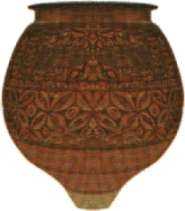
Many people stored food in large jars. A painted
storage jar, above, was found in Pakistan's Indus
Valley. It stands about 76 cm high.
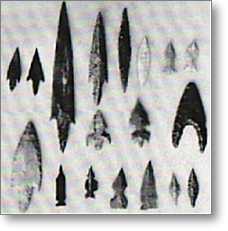
These arrowheads from Israel show that people continued
to rely on hunting. Animals bones found on sites from
the Mediterranean to the mountains of Iran also support
this view. Gazelle and deer, species never domesticated in
the Middle East, make up as much as 20 percent of the bones.

Domesticated grasses have ears containing seeds more
firmly attached to the stalk than in wild grasses.
Thus, grains could be harvested with a sickle such as
this one, made of flint blades set into a wooden frame.
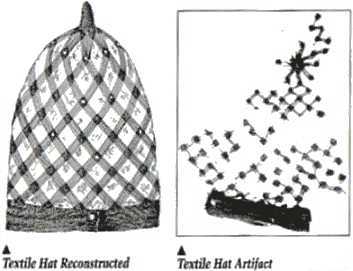
Textiles discovered at Nahal Hemar, in Israel, are the
earliest ever found. These organic materials survived
only because of the site's dry conditions. The textiles
are made of linen, a product of the flax plant, likely
domesticated by the Neolithic period. The piece appears
to be headgear.
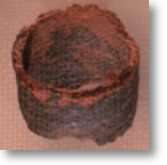
Containers of varying sizes and materials moved goods from
one location to another. Reed baskets and boxes could be
waterproofed by coating them with bitumen, a tarry substance
plentiful in many parts of the Middle East. One sample is
the box shown here. Other containers were made of skins,
cloth, or stone.
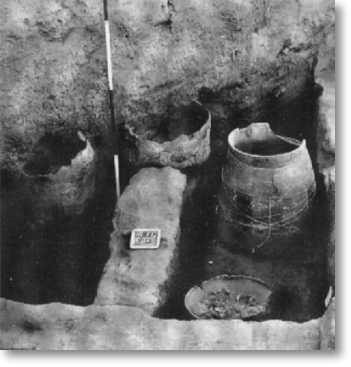
Large storage containers, such as this one from Iran, have
been found in many Neolithic homes. Made of pottery, these
containers kept grain dry and free of pests. As a container
for cooking, pottery opened up new ways of preparing food....
At about 12 500 BC, in many parts of Africa the toolkits of the prehistoric hunters undergo considerable change, marked by a drastic diminution in the size of the blades on which stone tools are made, coupled with an increase in the proportion of bone tools used. Bored stones, harpoons, and complex composite tools also appear for the first time in the prehistoric record. The skeletal remains of the Neolithic or Late Stone Age hunters are indistinguishable from those of modern man, and it is reasonable to suppose that, both materially and spiritually, the way of life differed little from modern hunting peoples such as the Southern African Bushmen.
Prehistoric farmers built larger, longer-lasting settlements than the camps that Paleolithic people had built. In the Middle East, for example, early farmers constructed their houses of solid, sun-dried mud. Dried mud was much more resistant to weather than the materials earlier people used, such as skins and bark. The early farmers also learned to build fences to confine and protect their livestock.
Neolithic people made inventions and discoveries at an even faster rate than did the people of the Upper Paleolithic. Early farmers developed a number of useful tools. These implements included sickles to cut grain, millstones to grind flour, and polished stone axeheads.
By about 11 000 BC, people had discovered how to make pottery. Before that time, they used animal skins or bark containers to hold water. To boil water, early cooks had to drop hot stones into the water, because they could not hang animal skins or bark over a fire. Pottery containers enabled people to hold and boil water easily. After the rise of agriculture, people used pottery to store grain and other food.
No one knows when people made the first objects out of metal. But metals became important only after metalworkers learned to make bronze, a substance hard and durable enough to make lasting tools. People of the Middle East made bronze as early as 3 500 BC....
The development of farming was an important step toward the rise of civilization. As farming methods improved and food became more plentiful, many people were freed from the jobs of food production. These people developed new skills and trades. In addition, the abundant food supply enabled more people to live in each community. In time, some farming villages became cities. The first cities appeared by about 3 500 BC. These cities were the birthplaces of modern civilization.
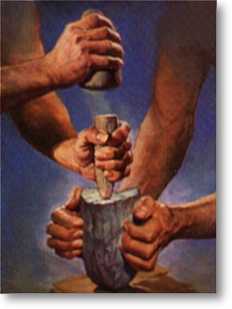
Later prehistoric people used more complicated toolmaking
techniques, such as the one shown.... This process,
employed by Upper Paleolithic people, required the cooperation
of two individuals. The toolmakers used two hard objects as
a hammer and chisel to split bladelike slivers from a large
stone. In this way, they could create many useful tools from
a single stone.
One of the most important new skills that they learned was how to make pottery. They made it from a mixture of clay, straw, and dung (animal waste). The straw kept the pottery from cracking when heated, and the dung gave the vessels extra strength. To build up a pot, people wound coils of the clay mixture in a circle and smoothed the sides. They then placed the pot in a trench, covered it with branches and straw, and set the kindling on fire. This early version of a kiln baked the pottery at a high temperature.
People of the Neolithic Age also learned how to make baskets, and how to weave cloth on a loom, an important invention of the age. They fashioned jewellery, eating utensils, weapons, and other goods from metal. Lumps of copper, lead, silver, and gold, found lying on the ground, they hammered into various shapes. [...] Trade led to new methods of transportation as Neolithic people began to think about better ways to transport their wares.
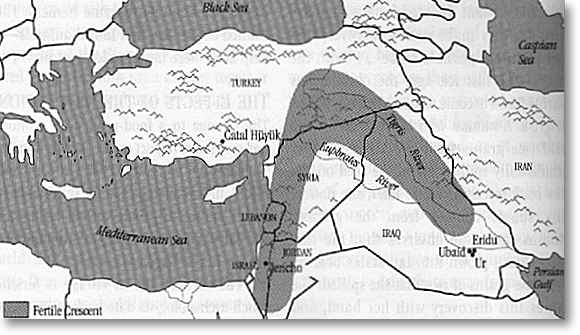
The "fertile crescent" in the Middle East, containing
the earliest known agricultural sites

- Fill in the gaps using educated guesses (if there are any).
Having read and analyzed the provided data, you may have discovered some gaps that are not covered by the information. If so, you will need to make educated guesses to "fill in the blanks." When you are done or if you found none, continue on to the next step.

- Use the provided sources of information to construct your own viewpoint on the aspect of the Neolithic Period for which you are responsible. Using the word processor on your computer, you will then type up your interpretation of the data, in your own words, in a well-developed paragraph complete with a topic sentence. Co-operation with your partner is essential here.
The time has come for all your diligent research to pay off.
Note: Please follow the instructions as they are given. Read this paragraph before continuing on.
You and your partner will now discuss your interpretations of the data, agree on a single standpoint, and record it. Using a word processor on your computer, type up a well-developed paragraph presenting your viewpoint on your particular aspect of the Neolithic Revolution. This paragraph must have a topic sentence such as: "Without regular increases in technology, many new possibilities associated with the Neolithic Revolution could never have been fully explored." Try to be creative with your viewpoint; it is hoped that every group will interpret the evidence in a different way. The length of the paragraph will obviously vary but try to stay within the range of 200 - 400 words. One person doing all the typing is perfectly fine providing that there is input from both members. As previously mentioned, co-operation is essential. You will probably be referring back to this page when writing, but write the paragraph in your own words.
Read through then follow:
- Open the Start Menu and find your desired word processor (Microsoft Word or Claris Works). Note that it may be under "Programs."
- You and your partner agree on a standpoint about the evidence and type it up in the form of a well-developed paragraph with topic sentence, in your own words (referring back to this page when necessary--be sure to keep the browser window open).
- Proof read your paragraph for grammatical faults, spelling errors, etc.
- When you have a final copy done, and are still in the word processor, hit the following keys:
- Ctrl-A (to select everything) then
- Ctrl-C (to copy it to the Clipboard)
- Print off a copy of your paragraph for each member of your group, both for evaluation and study purposes (File > Print).
- After retrieving your sheet from the printer, save the file on the computer under your name (File > Save As...) then continue to the next step, "Submit and Review."
Note: If you have difficulty with any of these steps or are not sure you understand completely, please confirm with your teacher before proceeding. To those groups on Mac's: use the apple function key in the place of Ctrl.

- Submit your paragraph to your peers to be read. This is where the technology really comes into play: You will post your paragraph on a message forum where others can read it and comment if they wish. You can do the same with other groups' paragraphs.
You must now have a final copy of your paragraph and are ready to go to the message board to submit it and read those the other groups have prepared. If you have never used a message board before: don't panic. There is nothing to them. Detailed instructions are at the message board. You may now enter.